
How Much Does a Uganda Gorilla Permit Cost?
How Much Does a Uganda Gorilla Permit Cost?
I Went to See Gorillas in Uganda. Let Me Tell You About the Cost.
I almost didn’t go. Not because I didn’t want to. Because I kept asking myself the same question over and over, usually late at night when my credit card was staring at me from my wallet: how much does a Uganda gorilla permit cost? And every time I looked it up, I got a different answer. Some blogs said one thing. Forums said another. It was driving me crazy.
So let me save you the headache. For most foreigners,
What Actually Happens
It’s 800.That′sit.One payment.One hour with the gorillas.Ifyou′refromEastAfrica,it′saround65. I know $800 sounds insane for sixty minutes. I thought so too. But then I went. And now I’m the annoying friend who won’t stop talking about it.
You wake up before the sun. Like, before the birds even start warming up. You eat something quick—bread, banana, coffee—because you don’t know when you’ll eat again. Then you drive to the park headquarters in the dark. The road is bumpy. You spill coffee on your shirt. It’s fine. Nobody cares.
At headquarters, they split everyone into groups. Each group gets one gorilla family. They ask how fit you are. Be honest. If you say you’re in great shape and you’re not, the mountain will find out. And it will punish you.
Then you start walking. Or climbing. Or pulling yourself up muddy slopes using tree roots like makeshift ropes. The time depends on where the gorillas decided to sleep last night. Could be thirty minutes. Could be four hours. I hiked for two and a half. My legs were shaking by the end.
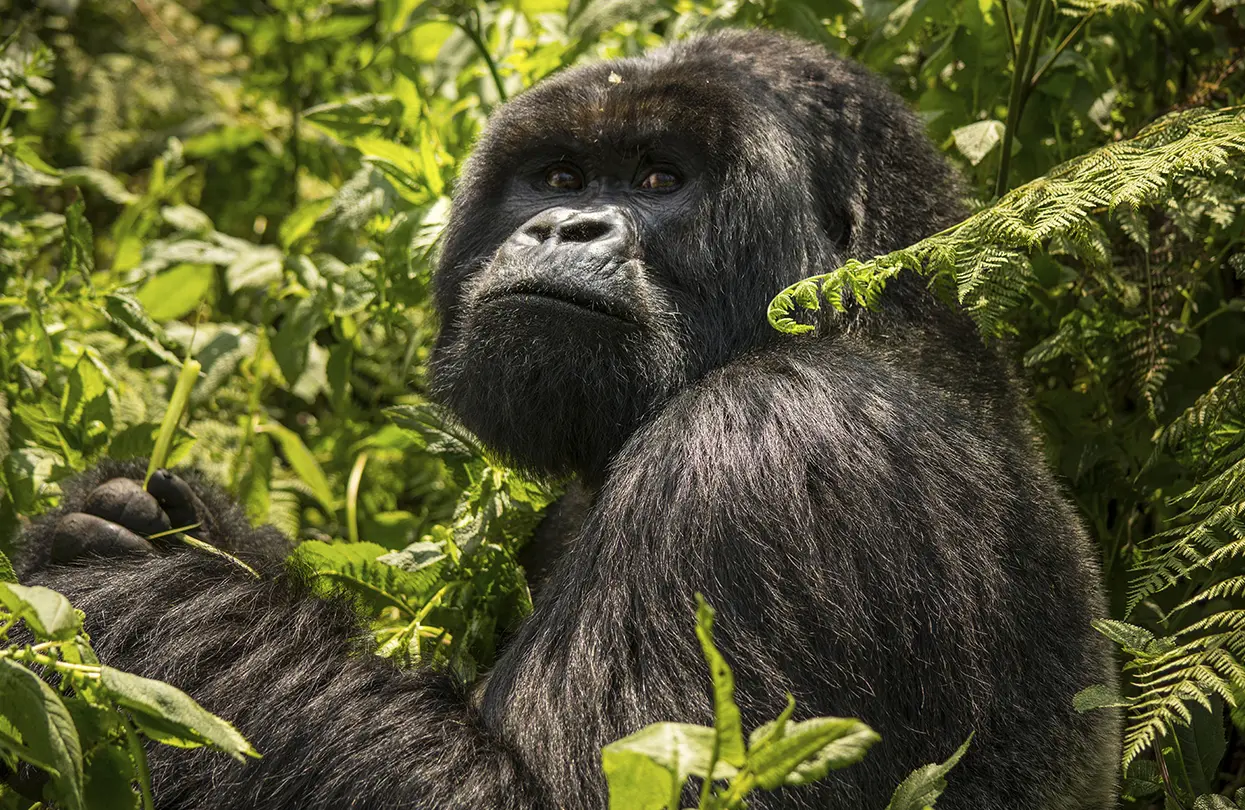
But then the trackers radio in. They’ve found them. You push through one last wall of vines, and suddenly—there they are. A silverback just sitting there, chewing on a stick like he’s waiting for the bus. He doesn’t care about you. That’s the amazing part. He’s completely unimpressed. And somehow that makes it even better.
Other Animals You Might Spot (If You Pay Attention)
Look, the gorillas are the main reason you’re here. I get it. But don’t walk through the forest with blinders on. There’s other stuff moving around you.
Golden monkeys, for one. They’re smaller than gorillas, bright orange-brown, and they move so fast you’ll think you imagined them. One second, they’re in a tree. Next second, they’re gone. Poof.
Birds everywhere. I’m not a bird nerd, but there’s this one called the great blue turaco that looks like a flying rainbow. Red wings. Blue body. Completely ridiculous. My guide pointed it out, and I nearly fell over trying to get a photo.
You might also see L’Hoest’s monkeys. They’ve got little white beards, like grumpy old men who’ve had enough of your nonsense. They sit in the trees and stare at you. It’s funny until you realize they’re staring at you.
Forest elephants exist here, but good luck seeing one. They’re shy. You’ll see their footprints. You’ll see broken trees. But the elephant itself? Probably not. And honestly, after hiking for hours, you might be okay with that.
The Cultural Part That
I didn’t expect the people to stick with me as much as the gorillas. But they did.
After the trek, I did something called the Batwa Experience. The Batwa used to live in the forest. For thousands of years, it was their home. Then the park came, and they had to leave. That’s a hard story to hear while you’re standing there in your expensive hiking boots.
But they don’t just tell you about it. They walk you into the forest and show you. This leaf? Stops bleeding. That root? Cures a fever. Watch how you start a fire with nothing but a stick and dry grass. I tried. I failed. They laughed. It was good.
Then they sang. I don’t know how to explain this without sounding cheesy, but their voices in that forest—it felt like the trees were humming along. I got goosebumps. My eyes got wet. Nobody saw. Or maybe they did. Either way.
You can also visit a village near the park. A woman named Florence taught me how to roast coffee in a big pan over an open fire. I burned my fingers. She handed me a cold drink and didn’t say I told you so. That’s real grace.
When to Go
Here’s the honest breakdown.
If you hate mud—like really, truly hate it—go in the dry season. That’s June to August or December to February. The trails are firmer. You won’t slide around. You also won’t have to deal with leeches. Yes, leeches. They’re tiny and harmless but still gross. I pulled three off my sock and screamed like a little kid. My guide thought it was hilarious.
The catch? Everyone else wants those months, too. Permits sell out fast. You need to book early.
If you don’t mind rain and you love having the forest almost to yourself, go in the wet season. March to May or September to November. The trails are muddier. Your boots will never be clean again. But the forest is so green it looks like a movie set. Lodges are cheaper. Fewer tourists. And gorillas don’t care about rain. They just sit there looking majestic while you drip everywhere.
Oh, and one more thing. How much does a Uganda gorilla permit cost during the wet season? Still $800. Same price. No discount. But sometimes tour operators lower their package prices, so the whole trip ends up costing less.
Where You’ll Sleep (From Fancy to Basic)
You’ve got options. Real options.
Fancy version: lodges like Sanctuary Gorilla Forest Camp or Clouds. Hot showers. Real beds. Food that feels like a celebration. You’ll fall asleep to monkeys running across your roof. It’s expensive but honestly worth it if you have the money.
Middle version: Engagi Lodge or Bakiga Lodge. Clean rooms. Good food. Friendly staff. Some of them are super close to the trailhead, so you can wake up and be hiking in fifteen minutes. No long drives in the dark. That’s a win.
Budget version: Ruhija Gorilla Guesthouse or Bwindi View Bandas. Simple rooms. Shared bathrooms. But the people are warm, and the price is right. Or stay in Kisoro town for like $30 a night. You’ll drive an hour to the park each morning, but you’ll save real money.
And please, please hire a porter at the trailhead. It’s about $20. They carry your bag. They pull you up the steep parts. They make the whole thing so much easier. Plus, that money goes straight to a local family. Just do it. You won’t regret it.
I asked myself how much a Uganda gorilla permit costs about fifty times before I finally booked it. I added up the flights, the lodging, the tips, everything. I almost said forget it.
Then I spent one hour sitting on the damp ground, ten feet away from a silverback named Rukina, watching his baby roll down a small hill and climb back up just to do it again. The baby fell three times. The dad didn’t move. Just watched. Like any parent anywhere.
That hour cost me $800. But the feeling of it—the way my chest got tight when the baby looked at me—that doesn’t have a price tag.
You’ll come home with muddy boots and sore legs and a thousand photos that don’t quite capture what it felt like. And you’ll tell the story so many times your friends will get sick of it. That’s okay. They’ll understand once they go too.
So book the permit. Pack your oldest pants. And go sit in the mud with some gorillas. You won’t be the same when you come back. In the best way possible.

Talk to us
- Email:
- Phone line:
- Whatsapp: