

Can I Take a Hot Air Balloon Over the Serengeti During Migration?
Can I Take a Hot Air Balloon Over the Serengeti During Migration?
So, You Want to Float Over the Serengeti During the Migration?
Let me just say this upfront: yes, you absolutely can.
But here’s the thing, nobody ever asks this question and actually wants a one-word answer. What they really want to know is: Is it as mind-blowing as it sounds? Will I actually see the wildebeest from up there? And is it really worth selling a kidney for?
I get it. Let’s talk honestly about what this experience is actually like.
First, Forget Everything You Know About Safari
If you’ve done game drives before, you know the drill: bouncing along dusty tracks, craning your neck for a leopard in a tree, your guide whispering into the radio. It’s incredible, don’t get me wrong. But it’s also… well, it’s ground-level.
A hot air balloon safari is the complete opposite.
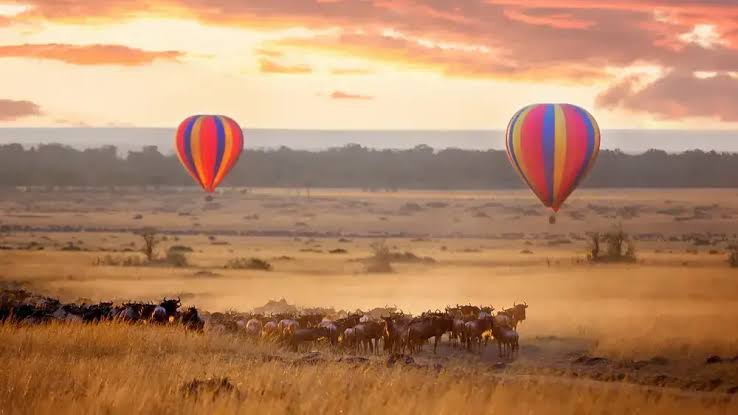
Picture this: It’s still pitch black, you’re bundled up in a fleece, clutching a cup of coffee, and suddenly this massive balloon starts to inflate right in front of you with a giant whoosh of flame. You climb into the basket, heart thumping, and then—silence. You lift off.
And as the sun cracks over the horizon, the entire Serengeti unfurls beneath you like a living map.
There’s no engine noise. No rumbling. Just the occasional whoosh of the burner and the sound of your own breathing. Below you, animals are just living their lives. Herds stretch as far as you can see, moving like slow rivers. Elephants look like tiny grey pebbles. Giraffes seem almost comical from above, their long legs looking like stilts.
It’s the kind of quiet that makes you feel really, really small—and really, incredibly lucky.
The Honest Truth About “Seeing the Migration” from Above
Okay, let’s get real for a second.
You know all those jaw-dropping photos you’ve seen of wildebeest plunging into the Mara River with crocodiles snapping at their heels? You probably won’t see that from a balloon. I’m not saying it’s impossible lightning does strike sometimes, but honestly? That’s a game-drive thing. You need to be parked on the riverbank, waiting for hours, to catch that kind of drama.
What you will see from the balloon is so much bigger than a single crossing.
You’ll see the scale of it all.
When you’re on the ground, a herd of wildebeest looks like a big crowd of animals. But from above? It looks like a living, breathing organism. Thousands upon thousands of them, snaking across the plains in lines that seem to go on forever. You realise you’re not just watching a few animals—you’re watching an entire ecosystem in motion.
I’ll never forget the moment our pilot pointed down and said, “Look—do you see those darker patches moving through the grass?”
It was a pride of lions, casually stalking a herd that had no idea they were there. From up there, you see the whole chessboard. The hunters. The hunted. The rivers. The bottlenecks. The escape routes. It completely changes how you understand the Serengeti.
Does the Time of Year Actually Matter?
Short answer: yes, but don’t overthink it.
The migration is always moving. Always. So the “best” time for a balloon safari really just depends on what you want to see.
-
If you’re there between January and March, you’ll probably be floating over the southern plains during calving season. And honestly? Watching thousands of tiny, wobbly-legged wildebeest calves dotting the grasslands from above is ridiculously cute. You’ll also see a lot of predator action—lions and cheetahs know this is the all-you-can-eat buffet season.
-
From April to June, the herds are on the move. From your basket, you’ll see these enormous columns of animals stretching for miles, like ants marching to some secret destination only they know.
-
July through October is when everyone flocks north. This is peak drama season. You might not see a river crossing from the air, but you will see huge clusters of animals gathered near the water, and the tension is almost palpable even from hundreds of feet up.
-
November to December, the herds are heading back south, and it’s still spectacular—just quieter, more spread out.
The beauty is, balloon operators are smart. They move their launch sites to wherever the animals are. So when you book, your safari operator will help you pick the right camp for that time of year.
Is It Really Worth the Price Tag?
A balloon safari will set you back anywhere from $550 to $700 per person.
I know. That’s a lot of Tanzanian shillings. When I first saw the price, I thought, “For a 45-minute ride? Really?”
But here’s the thing—you’re not paying for the ride. You’re paying for the moment.
You’re paying for a team of people who woke up at 3 a.m. to drive all the way out there, set up the balloon, check the wind, and make sure you’re safe. You’re paying for a pilot with years of experience who knows exactly where to drift for the best views. You’re paying for that champagne breakfast in the middle of nowhere, with hot coffee and fresh pastries, as zebras watch you from a distance.
And honestly? Sitting there, glass of bubbly in hand, watching the sun climb higher over the most beautiful place on Earth while a giraffe nibbles leaves a hundred metres away…
Yeah. It felt worth every single penny.
A Few Practical Things Nobody Tells You
-
It’s cold. Like, really cold at 5 a.m. Wear layers. Bring a beanie. Your hands will thank you.
-
The landing can be bumpy. Balloons don’t exactly have wheels. You might tip over, you might drag a bit, you might land in a slightly different spot than planned. That’s part of the adventure. Just hold on and enjoy the ride.
-
You can’t bring a giant camera bag. There’s limited space in the basket. Bring your phone or a compact camera with a strap. Trust me, you won’t want to be fumbling with a massive lens.
-
Book way in advance. Like, months in advance if you’re travelling during peak season. Spots fill up faster than you’d think.
Who Should (and Shouldn’t) Do This?
You’ll be fine if:
-
You’re generally healthy and mobile.
-
You’re over about 7 years old (some operators have age limits).
-
You’re okay with heights (it’s actually pretty gentle, but still).
You might want to skip it if:
-
You’re pregnant. (Balloon landings can be jolty, and operators are cautious for good reason.)
-
You have serious mobility issues; you’ll need to climb into the basket, which can be tricky.
-
You’re on a super tight budget, and the cost genuinely stresses you out. There’s no shame in that—game drives are already incredible.
Should You Do It?
If you can afford it without breaking your entire trip budget, do it.
Don’t do it because you think you’ll get the perfect Instagram shot. Do it because there’s something deeply magical about floating in absolute silence over one of the last great wild places on Earth, watching the world wake up from a perspective most people will never experience.
Will you remember the price tag five years from now? Probably not.
Will you remember the way the sunrise painted the grass gold, or the moment you spotted a herd of elephants from above, or the sheer, breath-taking quiet of it all?
Absolutely. Every single time.

Talk to us
- Email:
- Phone line:
- Whatsapp: