

What Is the Ngorongoro Crater and Why Is It Famous?
What Is the Ngorongoro Crater and Why Is It Famous?
Ngorongoro Crater: Honestly, It’s Like Nowhere Else on Earth
Let’s be real for a second. You can read about the Ngorongoro Crater a hundred times, but nothing—and I mean nothing—prepares you for the moment you actually stand on that rim and look down.
It hits you like a punch to the chest.
One minute, you’re driving through the misty highlands of northern Tanzania. The next, the world just… opens up. You’re staring into a giant, ancient bowl of green, stretching 600 meters down and 19 kilometers across. It doesn’t even feel like a place on Earth. It feels like you’ve stumbled into the lost world from a dinosaur movie.
This isn’t just another safari stop. This is the Ngorongoro Crater—and honestly? It’s pure magic.
So… What Actually Is This Place?
Okay, here’s the wild backstory.
About two or three million years ago, a volcano so massive it would make your head spin exploded. But instead of staying a mountain, its guts collapsed inward. The whole thing just caved in on itself.
What was left behind? This perfect, gigantic “sunken bowl”—what scientists call a caldera. Today, it’s the largest intact, unfilled one on the entire planet.
And here’s the coolest part: because the walls are so steep and tall, the animals that live down there don’t really leave. It’s like Mother Nature built her own private wildlife sanctuary and said, “You guys stay put, I’ve got something special for the humans to see.”
Where in the World Is This Wonder?
Your Gateway to the Eighth Wonder: The Ngorongoro Crater
Imagine standing on the edge of a collapsed volcano, peering down into a world so lush and wild that it feels like a scene from The Lion King. That is the magic of the Ngorongoro Crater.
Tucked away in the dramatic northern highlands of Tanzania, this natural marvel is perfectly sandwiched between the endless, golden plains of the Serengeti to the west and the vibrant, bustling town of Arusha to the east. It’s the crown jewel of the famous “Northern Safari Circuit,” and for good reason.
But the crater isn’t just a hole in the ground; it’s the heart of the expansive Ngorongoro Conservation Area, a UNESCO World Heritage Site that spans a staggering 8,000 square kilometers.
To put that into perspective, that’s nearly twice the size of the Grand Canyon! This isn’t just a park; it’s a living, breathing wilderness that supports over 25,000 large animals, from the rare black rhino to the iconic “Big Five.”
The Journey There: A Road Trip for the Soul
For most adventurers, the journey begins the moment you land at Kilimanjaro International Airport or Arusha Airport. After soaking in the vibrant culture of Arusha—often called the “Safari Capital”—you’ll buckle up for a scenic 3 to 4-hour drive that is an experience in itself.
As your 4×4 winds through the rolling, emerald-green hills, you’ll pass through the land of the Maasai. Watch as warriors in bright red shukas (cloths) herd their cattle against the backdrop of the Great Rift Valley.
You’ll wind through lush highland rainforests where the air gets cooler, and the views become more breathtaking with every turn. This isn’t just a transfer; it’s a road trip you’ll never forget, immersing you in the sights, sounds, and smells of authentic East Africa before you even catch your first glimpse of the crater floor.
Why This Safari Stands Out
While the Serengeti is famous for its nomadic wildebeest migration, the Ngorongoro Crater offers something more intimate: a permanent, concentrated wildlife spectacle.
Because the animals have little reason to leave the crater walls, your chances of spotting a lion stalking its prey or a hippo lounging in the hippo pool are incredibly high. It offers some of the best year-round game viewing on the planet, making it a non-negotiable stop on any Tanzania travel guide.
Why Does Everyone Lose Their Minds Over This Place?
Good question. And the answer isn’t just one thing—it’s a whole bunch of them.
First off, the wildlife is insane. And I don’t use that word lightly.
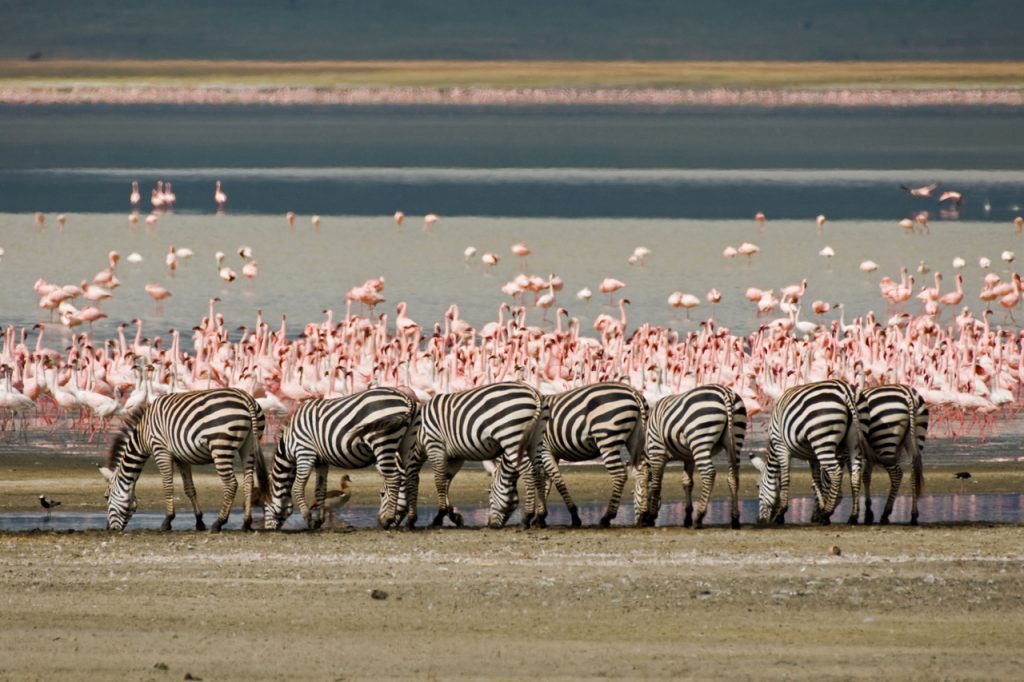
Because the crater acts like a giant natural fence, the animals don’t migrate away. They stay put. All year round. That means you’re not driving for hours, squinting into the distance, hoping to see a zebra. No, you drop down onto that crater floor, and BAM. Wildebeest. Zebras. Buffalo. Gazelles. Everywhere.
It’s like walking into a David Attenborough documentary.
And the Big Five? Oh yeah, you can see all of them—lions, leopards, elephants, buffalo, and those crazy-rare black rhinos—in a single morning. Not many places on Earth can promise that.
The Animals Don’t Just Exist Here—They Live Here
You’re sitting in an open Jeep, the morning sun warming your face. A massive bull elephant with tusks like tree branches is munching on acacia trees just a few feet away. A pride of lions is sprawled out on the grass like lazy house cats, bellies full, barely glancing your way. Hyenas are cackling in the distance, plotting their next move.
And then—quietly—a black rhino emerges from the mist.
Your heart stops. Your camera feels heavy in your hands because you know no photo will ever do this justice.
It’s raw. It’s real. And it’s happening right in front of you.
Even the birds are next-level. Flamingos turn the shallow Lake Magadi into a swirling sea of pink. Eagles soar overhead like they own the place. If you’re into birdwatching, you’ll be ticking off your list faster than you can say “crowned crane.”
It’s Not Just About the Animals, Though
Here’s something that surprised me when I visited: the crater isn’t just about safaris.
It’s a place where ancient human history and living culture crash into the present.
The Maasai people have been herding their cattle on these lands for generations. You’ll see them walking along the crater rim in their bright red shukas (robes), staff in hand, completely unfazed by the tourists snapping photos. They live with the wildlife—not separate from it. And honestly? It makes the whole experience feel so much deeper.
And if you’ve got the time, drive over to Olduvai Gorge nearby. It’s one of the most important archaeological sites on the planet. This is where some of our earliest human ancestors left their footprints. Standing there, looking at those fossil beds, you realize: we’re not just visitors here. This place is part of our story too.
The Best Part? You Can Visit Anytime
One thing I love about Ngorongoro is that it doesn’t have a “bad season.”
-
Dry months (June–October): The grass is short, animals are easier to spot, and they crowd around the waterholes.
-
Green months (November–May): The crater turns into this lush, emerald paradise. The skies are dramatic, the birds are showing off, and there are way fewer tourists.
Pick your vibe. Either way, the crater delivers.
Let’s Be Honest: It’s a Little Bit of Heaven on Earth
Look, I’ve been lucky enough to see a lot of beautiful places. But the Ngorongoro Crater? It stays with you.
It’s not just the wildlife or the views. It’s the feeling. The hush that falls over you when you’re 600 meters down, surrounded by towering walls, watching elephants stroll through grasslands and flamingos paint the lake pink. It’s the wind in your hair, the smell of the earth, and the quiet realization that you are so small in the grand story of this planet.
If you’re planning a trip to Tanzania, do yourself a favor: don’t just skip past this one. Savor it. Spend a night on that rim, watch the sunrise spill into the crater, and let it knock your socks off.

Talk to us
- Email:
- Phone line:
- Whatsapp: