

Can I Camp Inside the Ngorongoro Crater?
Can I Camp Inside the Ngorongoro Crater?
You Want to Camp Inside the Ngorongoro Crater?
I get it. You’re scrolling through photos of that insane caldera, lions lounging in the grass, elephants marching through the mist, and you think: I need to be in there. Like, right in the middle of it. Sleeping under the stars with the big cats.
It’s a dream. And it’s also, unfortunately, a total fantasy.
The short, heartbreaking truth? No. You absolutely cannot camp on the crater floor.
But before you close this tab in disappointment, hear me out—because the alternative is actually better than you’d expect. I promise.
Why the Crater Floor Is a Firm “No”
Look, I know the rules feel annoying. You’re thinking, “But I’m a responsible traveler! I’ll be quiet! I’ll leave no trace!”
And I believe you. But here’s the thing: the crater floor is basically a 260-square-kilometer wildlife highway, 24/7. We’re talking lions, hyenas, grumpy buffalo, and elephants with zero patience for human nonsense.
Picture this: it’s 2 AM. You’re in a flimsy tent. A hyena lets out that eerie, cackling laugh about ten feet from your head.
Not so romantic anymore, right?
Beyond the sheer terror (okay, I’m exaggerating—but only a little), the authorities have good reasons for the ban. They’re protecting the animals’ natural behavior, keeping the ecosystem balanced, and making sure the crater doesn’t turn into a polluted, traffic-jammed mess.
So, the rule is ironclad: everyone—and I mean everyone—clears out of the crater by sunset. You go up, they stay down. Fair trade.
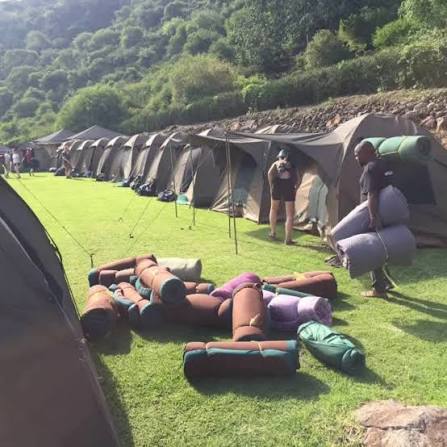
Here’s What Your Actual Crater Day Looks Like
Honestly? You’re not missing out by not sleeping down there. The day trip is epic.
You’ll wake up before the sun (yes, it hurts, but it’s worth it), grab a coffee, and descend into the crater as the morning light hits. That’s when the magic happens. Animals are active, the air is crisp, and you get that front-row seat to nature’s greatest show.
You’ll spend hours driving around spotting lions dozing on the plains, hippos looking like grumpy boulders in the water, and, if you’re lucky, that shy black rhino peeking through the bushes.
Lunch? Picnic by the hippo pool. (Keep your sandwich close—those birds are thieves.)
By late afternoon, you’re heading back up the crater wall, exhausted, camera full, heart full. You leave the crater to the animals, just as it should be.
The Real Magic Happens on the Rim Anyway
Here’s the thing nobody tells you: camping on the crater rim is actually the cooler experience.
I’m not just saying that to soften the blow. At over 2,200 meters high, you get these ridiculous panoramic views that make you feel like you’re on top of the world. You wake up, unzip your tent flap, and boom—the entire caldera is laid out at your feet like a wildlife diorama.
And the sounds at night? Unreal.
You’ll be sitting around the campfire, and suddenly—roar. Distant. Deep. Primal. A lion calling from somewhere far below. Or hyenas whooping it up in the dark. It’s spine-tingling stuff. You’re close enough to feel connected, but safe enough to actually sleep.
it gets cold. Like, shiver-in-your-sleeping-bag cold. We’re talking below 10°C. Pack like you’re going to a mountain cabin, not the beach. Fleece, thermals, thick socks—don’t be that person begging for blankets at midnight.
Your Camping Options (Because Yes, You Can Still Pitch a Tent)
Simba Campsite – The Budget Favorite
If you’re watching your wallet, Simba Campsite is the spot.
It’s right on the rim, has basic facilities (toilets, showers, a place to cook), and you’ll meet a cool mix of overland truckers, backpackers, and solo adventurers.
The views are fantastic. The vibe is laid-back. And sometimes zebras just wander through like they own the place (which, let’s face it, they kind of do).
Special Campsites – For the “I Want Solitude” Crowd
If you’ve got a bit more cash and want to escape the crowds, your tour operator can book a Special Campsite.
These are more remote, way quieter, and have minimal facilities—meaning your guide brings everything. Tents, tables, and even a camp chef if you’re lucky. It’s old-school safari, the kind you see in documentaries. No Wi-Fi, just wilderness.
Luxury Tented Camps – Glamping at Its Finest
Let’s be real: not everyone wants to sleep on the ground. And that’s totally fine.
The luxury tented camps on the rim are gorgeous. Think proper beds, hot showers, amazing food, and staff who remember your name. But you still get that canvas-tent safari feel—the sounds, the smells, the stars.
It’s the best of both worlds. Perfect for honeymooners or anyone who wants adventure without the backache.
Camping Here Is About More Than Just Animals
Ngorongoro Conservation Area: More Than a Safari Destination – A Living Cultural Landscape
When planning a Tanzanian safari, most travelers immediately think of the Ngorongoro Crater—a breathtaking natural wonder and UNESCO World Heritage Site. But here’s a crucial detail that many guidebooks overlook: Ngorongoro is not a national park. It is officially designated as the Ngorongoro Conservation Area (NCA), and that distinction makes all the difference.
Why does this matter? Because, unlike national parks, where human habitation is restricted, the Ngorongoro Conservation Area was specifically established to protect both wildlife and the traditional way of life of the Maasai people. That’s right—people live here, side-by-side with lions, elephants, rhinos, and wildebeest.
The Maasai: Guardians of the Land
At the heart of this unique coexistence are the Maasai, a semi-nomadic pastoralist community known for their vibrant red and blue shukas (traditional cloaks), intricate beadwork, and profound spiritual connection to the land. For centuries, the Maasai have grazed their cattle across these sweeping plains, living in harmony with the region’s iconic wildlife. Their cattle are not just livestock—they are a measure of wealth, a source of sustenance, and a cornerstone of Maasai identity.
When you visit Ngorongoro, you’re not just entering a wilderness; you’re stepping into a living, breathing cultural tapestry. The Maasai’s deep ecological knowledge and sustainable practices have helped maintain the delicate balance between nature and human activity, making the NCA a global model for multiple land-use conservation.
Immersive Cultural Experiences: Beyond the Big Five
Staying in or around the Ngorongoro Conservation Area offers far more than wildlife-viewing opportunities. Many eco-lodges, tented camps, and tour operators now offer authentic Maasai village visits, giving travelers the rare chance to:
-
Engage with Maasai elders. Sit under an acacia tree and listen to oral histories, legends, and wisdom passed down through generations.
-
Learn about traditional customs. Discover the significance of age-set ceremonies, cattle-based economies, and the Maasai’s intricate social structures.
-
Participate in daily life, witness (or even try) traditional dancing, fire-making, and beadwork crafting.
-
Gain a deeper understanding of conservation – Hear how the Maasai view wildlife not as competitors, but as part of a shared ecosystem—a perspective that enriches any safari experience.
Why This Matters for Your Trip
Adding a cultural component to your Ngorongoro itinerary does more than check a box—it transforms your journey. Instead of just observing animals from a vehicle, you’ll come away with real stories, real connections, and a richer appreciation for the land and its original stewards. You’ll see the crater not just as a stunning geological feature, but as a homeland—a place where nature and humanity have learned to thrive together.
To ensure an authentic and respectful experience, choose local tour operators who work directly with Maasai communities and prioritize fair-trade tourism practices. Always ask permission before taking photographs, and be open to learning—not just visiting.
When Should You Go?
Dry season (June–October) is the classic choice. Clear skies, easy roads, animals everywhere. But those nights are bitterly cold. Bring everything warm you own.
Green season (November–May) is underrated. Yes, it rains. Yes, it gets muddy. But the landscapes turn lush and photogenic, birds are everywhere, and there are way fewer tourists. If you don’t mind a little mud on your boots, it’s magical.
Packing Reality Check
Can I be real with you for a second? Most people pack incorrectly.
They think “Africa = hot” and show up in shorts. Then they freeze their butts off at 6 AM on the crater rim.
Pack:
-
Fleece jackets and thermal layers
-
A warm hat and gloves (yes, really)
-
A sleeping bag that’s actually warm (not that flimsy summer one)
-
A headlamp—campsites get dark
-
And obviously, your camera and binoculars
Is Camping Near the Crater Worth It?
Honestly? It’s one of those travel moments that stays with you forever.
Sure, you can’t sleep inside the crater. And yeah, that stings a little. But waking up on that rim, coffee in hand, looking down at one of the most incredible wildlife spectacles on Earth, hearing lions roar in the distance…
That’s not a compromise. That’s a privilege.
So go. Book that campsite. Pack your warmest socks. And get ready for a safari experience that’s raw, real, and absolutely unforgettable.

Talk to us
- Email:
- Phone line:
- Whatsapp: