

Can You See The Great Wildbeast Migration On Group Safari
Can You See The Great Wildebeest Migration On Group Safari?
For many travelers planning a trip to Tanzania, there is one experience that rises above almost everything else. Long before flights are booked or safari bags are packed, people picture themselves standing in the middle of the African wilderness watching thousands of animals move across endless plains. It is one of those travel dreams that feels larger than life.
The Great Wildebeest Migration has that effect on people.
You see the photographs and documentaries and immediately imagine yourself there. Vast landscapes covered with moving herds. Dust floating through golden light. Zebras running alongside wildebeests. Lions waiting nearby. The whole scene feels almost unreal until you begin planning a safari and suddenly realize this could actually happen.
Then another question naturally comes up.
If you join a group safari instead of a private one, can you still experience the migration properly?
Many first-time travelers quietly worry about this. Some assume that group safaris mean compromises. Others wonder if shared tours only visit general wildlife areas while private travelers get better access. It is a common concern, especially for people spending years dreaming about this trip.
The reassuring answer is yes, you absolutely can see the Great Wildebeest Migration on a group safari.
Not only that, but for many travelers, group safaris end up becoming one of the best ways to experience it.
The Migration Is Much Bigger Than People Imagine
Part of the confusion comes from the way people talk about the migration. It is often described as if it happens in one place at one exact moment.
People imagine a giant herd beginning a journey somewhere and eventually arriving somewhere else.
The reality feels much more natural and much more unpredictable.
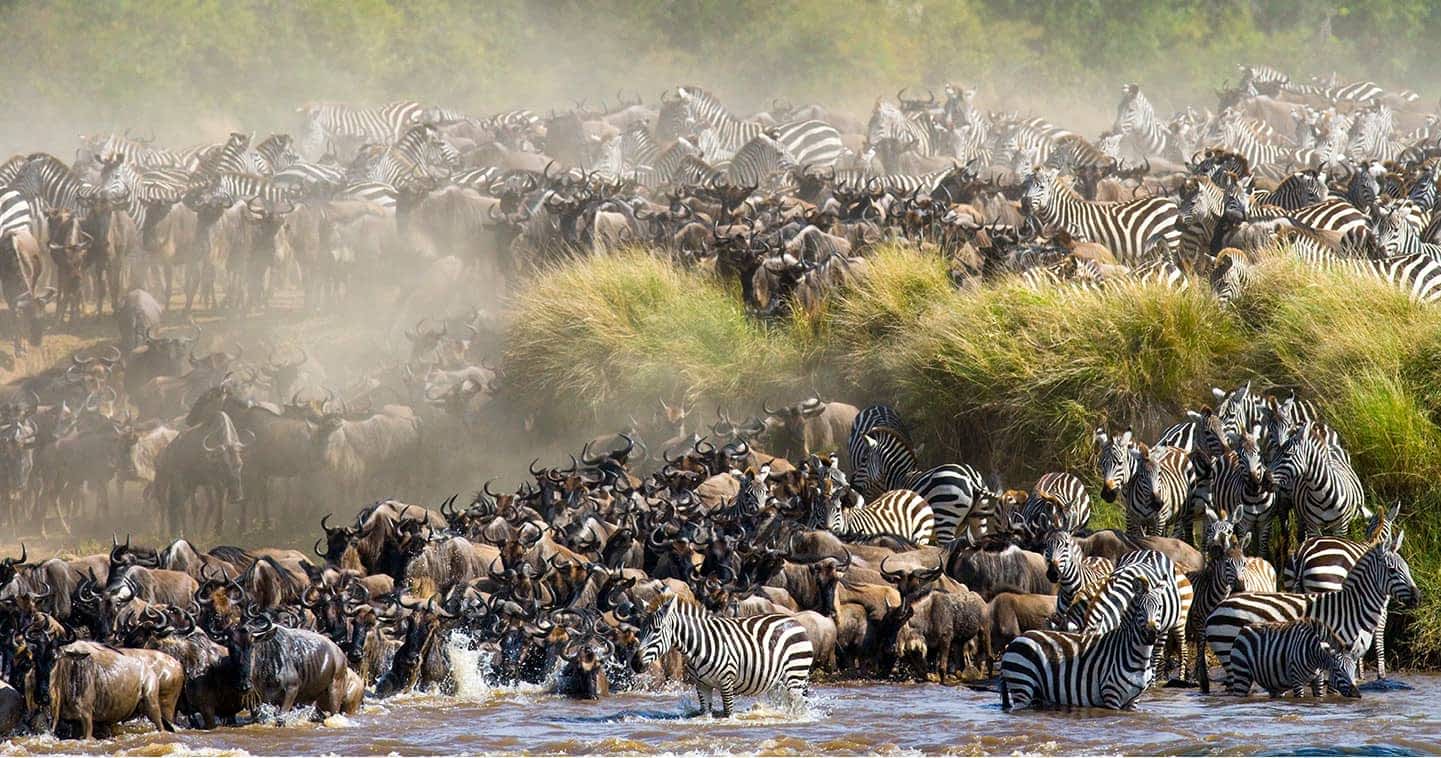
The Great Wildebeest Migration is a continuous movement involving millions of wildebeests, along with zebras and gazelles, traveling through ecosystems as they search for water and fresh grazing areas. The herds shift with changing weather conditions and seasonal rains.
Nature follows its own rhythm.
Animals move when they need to move.
Rain changes everything.
Grass grows in one area and disappears in another.
So instead of one event, the migration becomes an ongoing cycle happening throughout the year.
That is why no two safari experiences ever feel exactly alike.
Some travelers visit during calving season and find themselves surrounded by newborn animals taking their first steps across open plains. Others arrive when giant herds are spread across central landscapes. Some experience dramatic river crossings where animals hesitate for long periods before suddenly charging into rushing water.
There is no script.
And strangely enough, that unpredictability becomes part of the magic.
Group Safaris Are Often Designed Around Wildlife Seasons
People sometimes think group safaris are randomly organized trips where everyone simply follows a standard route.
That is usually not how good safari planning works.
Safari operators understand exactly why people travel to Tanzania. They know travelers want unforgettable wildlife experiences. They know many guests have spent years dreaming about the migration.
Because of that, group safari itineraries are often created around seasonal wildlife movements.
If migration activity is expected in a certain region during a particular period, routes may be adjusted to increase opportunities for sightings.
That planning matters more than many travelers realize.
Instead of trying to understand complicated migration patterns yourself, experienced guides and safari planners handle much of it behind the scenes.
For first-time visitors, that can feel like a huge relief.
You do not have to wake up wondering if you made the wrong decision or picked the wrong location.
People who spend their lives following wildlife have already done that work.
Sometimes The Waiting Becomes Part Of The Experience
One thing safari documentaries rarely show is how much waiting can happen.
People often imagine nonstop action from sunrise until sunset.
But nature moves at its own pace.
And sometimes those quiet moments become unforgettable.
Imagine your safari vehicle stopping near a riverbank after hearing reports of nearby herd activity. In the distance, animals gather near the edge of the water.
Nothing happens immediately.
Minutes pass.
The animals walk closer.
Then they step back again.
You wait.
Everyone waits.
No one speaks very much.
You hear cameras shifting, wind moving through grass, and distant animal sounds.
Then suddenly one wildebeest jumps.
Within seconds everything changes.
The hesitation disappears.
Thousands begin moving.
Dust rises everywhere.
Water explodes upward.
Animals push forward while others follow behind.
People in the vehicle start reacting at the same time.
Someone laughs.
Someone gasps.
Someone completely forgets to take photos because they are staring in disbelief.
Those moments feel impossible to recreate.
And surprisingly, experiencing them with other people often makes them even better.
Shared Safaris Create Unexpected Memories
Before traveling, people sometimes focus entirely on wildlife.
After traveling, many realize their favorite memories included people too.
Group safaris bring together travelers from different places, different backgrounds, and different stories.
At first everyone feels like strangers.
But something interesting happens after spending long days together driving through wildlife areas.
People start sharing excitement.
Conversations begin naturally.
Someone spots elephants before everyone else.
Someone points out a leopard hidden in a tree.
People exchange stories over meals.
By the end of the journey, the atmosphere often feels very different from the first day.
Safari experiences have a way of bringing people together because everyone is sharing the same sense of wonder.
Years later, travelers sometimes remember the friendships almost as much as the wildlife itself.
The Biggest Factor Is Timing, Not Safari Type
This may be the most important thing anyone planning a migration safari should remember.
The choice between private and group travel matters far less than timing.
You could choose the most luxurious private safari imaginable, stay in beautiful camps, and enjoy complete flexibility.
But if wildlife movements have shifted elsewhere, migration viewing may still be limited.
Meanwhile, a well-timed group safari can place travelers directly where migration activity is strongest.
That is why travel timing matters so much.
Different seasons bring completely different experiences.
Some months focus on newborn animals.
Others bring massive moving herds.
Certain periods create dramatic river crossing opportunities.
The migration keeps changing.
And experienced guides spend enormous amounts of time understanding those changes.
The Reality Feels Different From The Dream
People spend years imagining what the Great Wildebeest Migration will feel like.
Then they finally see it.
And something unexpected happens.
The scale feels bigger.
The sounds feel louder.
The landscapes feel wider.
Photographs suddenly seem too small to capture it properly.
You stand there looking across a horizon filled with movement and realize you are watching one of nature’s oldest and most remarkable cycles continue exactly as it always has.
At that point, you stop thinking about whether you arrived on a group safari or a private one.
You simply stand there and watch.
And for a little while, everything else becomes unimportant.

Talk to us
- Email:
- Phone line:
- Whatsapp: