

What Is the Best Safari Vehicle for Tanzania Roads?
What Is the Best Safari Vehicle for Tanzania Roads?
What’s the Best Safari Vehicle for Tanzania?
Picture this: You’ve just landed in Tanzania. The air smells different—warmer, earthier. You’ve got your camera bag, your floppy hat, and that giddy feeling you only get before a big adventure. You climb into your safari vehicle, ready to spot lions and elephants…
Suddenly, that “cool-looking” jeep doesn’t feel so cool anymore. Your back is complaining, your knees are cramped, and you’re bouncing around like popcorn in a pan.
Here’s the thing nobody tells you: your safari vehicle isn’t just a ride—it’s your home on wheels for days on end. And choosing the wrong one? That’s a fast track to a sore back, missed photo ops, and a whole lot of regret.
So let’s talk about what actually works on Tanzania’s roads—and what doesn’t. No jargon, no fluff. Just the honest, boots-on-the-ground truth.
Let’s Talk About Those “Roads”
If you’re imagining smooth, paved highways winding through the bush, I’ve got news for you.
Sure, the big roads between cities like Arusha and Dar es Salaam are nice and tarmacked. But the moment you enter a national park? All bets are off.
We’re talking dusty gravel tracks that turn into rivers of mud when it rains. Washboard surfaces that rattle your teeth. Deep sand that swallows tires. Rocky paths that make you appreciate every single bolt on your vehicle.
And during the rainy season? Let’s just say I’ve seen vehicles get stuck up to their axles. It’s not pretty.
That’s why the locals—guides, drivers, camp managers—all agree on one thing: you don’t mess around when it comes to your wheels out here.
The Unspoken Hero: The Toyota Land Cruiser
If you ask any guide in Tanzania what vehicle they trust with their life (and their guests’ lives), they’ll say the same thing: Toyota Land Cruiser.
It’s not glamorous. It’s not flashy. But my goodness, it works.
These things are built like tanks. They’ve been bouncing over the African bush for decades, and they just keep going. I’ve seen Land Cruisers with 400,000 kilometers on the clock still purring like kittens. They climb hills that would make a mountain goat nervous, cross rivers that look more like lakes, and drag themselves through mud that could swallow a small car.
But here’s the best part: they’re comfortable.
After a full day of game driving—sunrise to sunset—you’ll be thanking the heavens for those cushy seats and smooth suspension. Trust me, your back will know the difference.
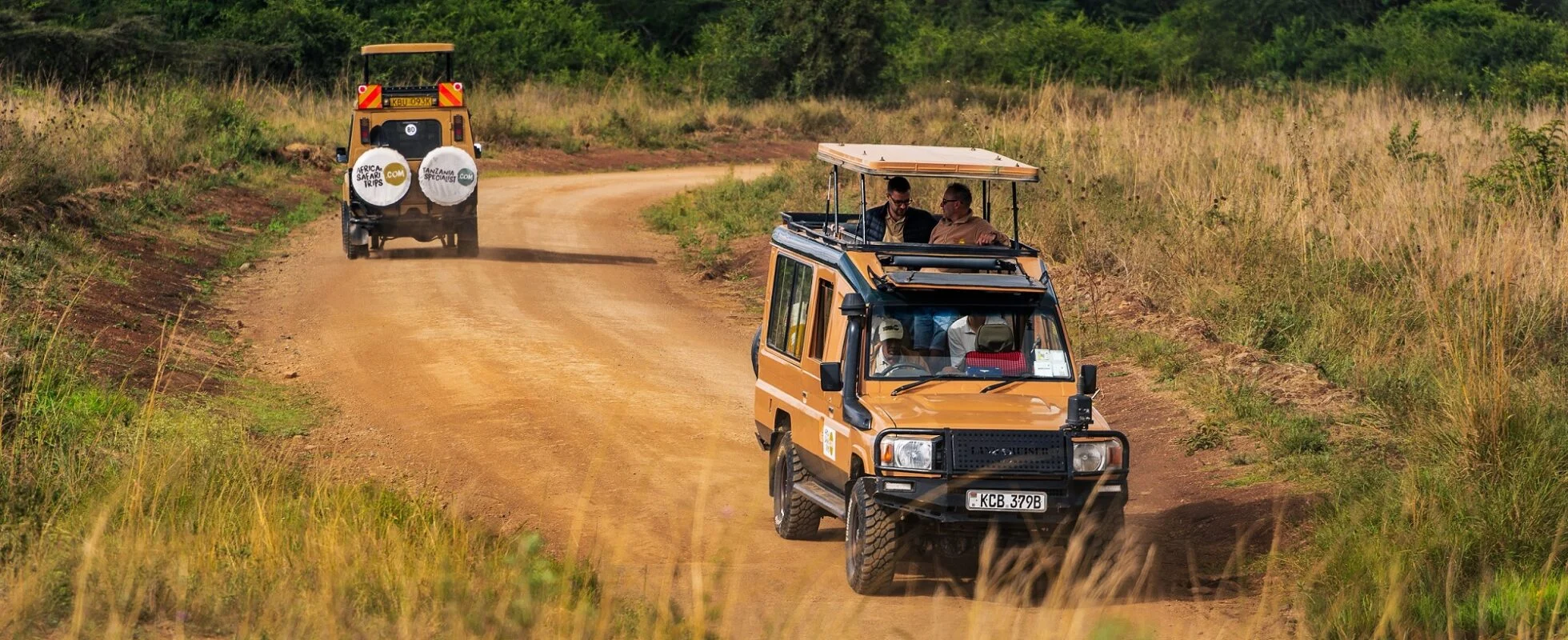
The “Safari-Spec” Land Cruiser
Most good safari companies don’t just hand you a standard Land Cruiser. They use custom-built safari vehicles—and they are absolute game-changers.
-
Pop-up roof – This isn’t just for show. You stand up through it, and suddenly you’re eye-level with giraffes, scanning for predators, and getting that perfect shot over the grass. It’s like having a front-row seat to nature’s greatest show.
-
Guaranteed window seat – No fighting over who gets the best view. Everyone gets one.
-
Charging ports everywhere – Because your phone, camera, and power bank will all be crying for juice by midday.
-
Fridges – Yes, cold drinks and snacks on a hot game drive. Absolute luxury.
-
Extra storage – Room for all your gear, luggage, and those souvenirs you swear you won’t buy (but you will).
When you’re in one of these, you’re not just surviving the safari—you’re thriving.
Station Wagons: Perfect for Couples and Small Groups
If you’re traveling with your partner, a couple of friends, or your immediate family, the Land Cruiser station wagon is your sweet spot.
It fits about 4 to 7 people, gives everyone a great view, and feels cozy without being cramped. Guides love these because they’re nimble—they can spin around quickly when someone spots a leopard, and everyone gets to see it before it vanishes into the bushes.
Plus, the enclosed cabin keeps the dust out. And let me tell you, the dust in the Serengeti is no joke. It gets everywhere.
Going Big? Extended Land Cruisers Have You Covered
Traveling with a bigger crew? Maybe a multi-generational family trip or a group of friends?
Extended Land Cruisers add more seats without sacrificing that legendary off-road capability. Tour operators are smart about arranging seating so that nobody feels left out—you’ll all get window time, I promise.
Even with more people on board, these beasts handle the rough stuff like champs.
Troop Carriers: For the Wild at Heart
Now, if you’re the adventurous type—I’m talking mobile camping, remote wilderness, sleeping under the stars—you might end up in a Land Cruiser Troop Carrier.
These things are pure utility. They carry everything: tents, cooking gear, supplies for days. They’re not pretty, but they’re tough as nails.
I’ve been in Troop Carriers on research trips and photography expeditions deep in Ruaha, where you don’t see another vehicle for hours. They give you this incredible sense of freedom—like you could drive to the edge of the earth and back.
What About Those Minivans? (Spoiler: Skip ‘Em)
You might see photos of safari minivans—especially if you’ve looked at Kenya trips. They’re common over there.
But in Tanzania? Most guides will quietly shake their heads.
Minivans have lower ground clearance and weaker 4WD systems. On a dry, well-graded road, they’re fine. But throw in some rain, a muddy patch, or a rocky incline? They struggle. Badly.
I’m not saying you can’t do a safari in one. But why take the risk? You’re spending good money on the trip of a lifetime. Do yourself a favour and go with a Land Cruiser. Future you will thank you.
Why 4WD Isn’t a “Nice-to-Have”
Look, I know it sounds like marketing hype. But four-wheel drive on a Tanzanian safari isn’t a luxury—it’s survival.
Roads change by the hour. The track you drove this morning might be a mudslide by afternoon. You need a vehicle that can handle:
-
Slippery slopes
-
Loose gravel
-
Sandy patches
-
Water crossings
-
Steep crater descents
Without 4WD, you’re limited to the main routes. And the main routes? That’s where everyone else is. The real magic—the hidden valleys, the quiet watering holes, the secret predator spots—you’ll miss all of it.
Comfort? Oh, It Matters More Than You Think
Let’s be honest: you’re going to spend hours in this vehicle.
Some days, you’re out before sunrise and don’t get back until sunset. That’s 10, 12 hours of bouncing along dirt tracks.
If your seat is hard, your legs are cramped, and there’s no airflow… well, let’s just say the lions won’t be the only ones getting grumpy.
A good safari vehicle gives you:
-
Properly cushioned seats
-
Plenty of legroom
-
Good ventilation
-
Easy entry and exit (important when you’re hopping in and out for photos)
The difference between a well-designed safari vehicle and a regular SUV is like night and day. You’ll feel it in your bones by day three.
Let’s Talk Wildlife Viewing
Here’s the thing: spotting animals in the wild isn’t like going to the zoo. They’re not waiting around for you.
You need every advantage you can get. And the right vehicle gives you that edge.
Custom safari Land Cruisers put you higher up, so you can see over tall grass and bushes. The windows are big, the roof pops open, and you can swivel your head in every direction.
I’ve been on drives where we spotted a leopard because someone stood up through the roof and caught a glimpse of its tail flicking in a tree. You just don’t get that in a standard car.
A Note to Photographers
If you’re a fellow camera nerd (and I mean that with love), listen up.
Your safari vehicle is practically part of your camera kit.
You need:
-
Wide, stable window openings for clean shots
-
Roof access for elevated angles
-
Room for your gear—because you know you’re bringing too much
-
Flexibility to move around and frame that perfect shot
I’ve spent hours waiting in a Land Cruiser for a cheetah to lift its head, and I can tell you—being comfortable, stable, and able to adjust my angle on the fly made all the difference.
Open-Sided Vehicles: Magical, But Not for Everyone
Some luxury camps use open-sided vehicles. They’re incredible for short, local game drives. You hear everything—birds, rustling leaves, distant roars. You smell the wet earth after rain. It’s immersive in a way that makes your heart sing.
But for long-distance travel? Dust, sun, and rain become real issues. For multi-park trips, you’ll want an enclosed Land Cruiser. Save the open-air experience for sundowner cruises near camp.
Best Wheels for Tanzania’s Star Parks
Serengeti
Vast plains, endless tracks, and epic wildlife. A customized Land Cruiser is your best friend here—durable, high-riding, and ready for anything.
Ngorongoro Crater
That steep descent needs solid 4WD. Land Cruisers handle it smoothly, and on the crater floor, their stability is a lifesaver on muddy tracks.
Ruaha & Nyerere (Southern Circuit)
These parks are wilder, more remote, and less crowded. Roads are rougher. A Land Cruiser or Troop Carrier gives you the toughness you need to explore off the beaten path.
Should You Self-Drive
Yes, it’s possible. You can rent a Land Cruiser and do it yourself. But unless you’re experienced with off-road driving, navigation, and bush mechanics, it’s a lot to take on.
Guides aren’t just drivers—they’re storytellers, trackers, and problem-solvers. They know where the animals hide, how to read the bush, and when to push on or turn back.
If you’re heading to Tanzania, do yourself a favour and book a trip with a customized Toyota Land Cruiser.
It’s reliable, comfortable, and designed specifically for the incredible—and sometimes unforgiving—terrain you’ll encounter. Whether you’re chasing the Great Migration, peering into the Ngorongoro Crater, or getting lost (in the best way) in the southern wilderness, this vehicle will treat you right.
When you’re planning your safari, ask about the vehicle. Don’t assume—check. The right one doesn’t just get you around; it makes your whole trip smoother, more comfortable, and infinitely more memorable.
Choosing the right vehicle is just one piece of the puzzle. From packing lists to park tips, there’s so much more to plan. But don’t worry—I’ve got you covered.

Talk to us
- Email:
- Phone line:
- Whatsapp: