

When Does the Great Migration Cross the Mara River?
When Does the Great Migration Cross the Mara River?
Do you want to see the Mara River Crossing? Let’s Talk About Timing.
Let’s be honest. If you’re here, you’ve probably spent way too many evenings scrolling through Instagram, watching those insane videos of wildebeest hurling themselves off riverbanks while crocodiles snap at their heels. And now you’re thinking: I have to see that with my own eyes.
But then comes the panic. When do I go? What if I book the wrong week? What if I spend a small fortune and end up staring at an empty river for three days?
Deep breath. I’ve been there. And here’s the raw, unfiltered truth about when the Great Migration crosses the Mara River—and why the answer is way more about feeling than it is about dates on a calendar.
The Honest Answer (Spoiler: There Isn’t a Set Date)
If I told you “the crossings happen in August,” I’d be lying to you. Well, mostly lying.
The truth is, the wildebeest don’t have iPhones. They don’t check a schedule. They cross the river when their bellies tell them to. When the grass on the other side looks greener (literally), and when the tension in the air builds up so much that one brave—or maybe terrified—animal finally takes the leap, and the rest just… follow.
Generally speaking, the chaos unfolds between July and October.
-
July is when the nerves kick in. The herds show up, they pace the banks, they stare at the water like it’s a monster. The tension is thick.
-
August is usually the fireworks. This is when the floodgates open, and you’ll see the biggest, most dramatic crossings.
-
September still delivers the goods. The herds are spread out, crossing back and forth like they can’t make up their minds.
-
October is the final encore. The herds start drifting south again, and you might catch one last hurrah.
But here’s the kicker: I’ve seen a massive crossing happen on July 20th one year, and the very next year, absolutely nothing happened until August 15th. Why? Rain. Plain and simple. If the rains come early, the grass grows early. If the rains are late, the animals wait. And they will make you wait right along with them.
The Emotional Rollercoaster of the “Wait”
Nobody warns you about this part.
You wake up at 4:30 AM, grab your coffee, and bump across the savannah in a Land Cruiser to find the herds. And there they are. Thousands upon thousands of wildebeest, stretching as far as the eye can see, all gathered at the edge of the Mara River.
And then… nothing.
They stand there. They moo. They shuffle left. They shuffle right. A zebra brays in frustration. A wildebeest calf gets brave, steps one hoof into the water, and then SPRINTS back like the river bit him.
You sit there for hours. The sun gets hot. The dust gets in your teeth. You start questioning all your life choices.
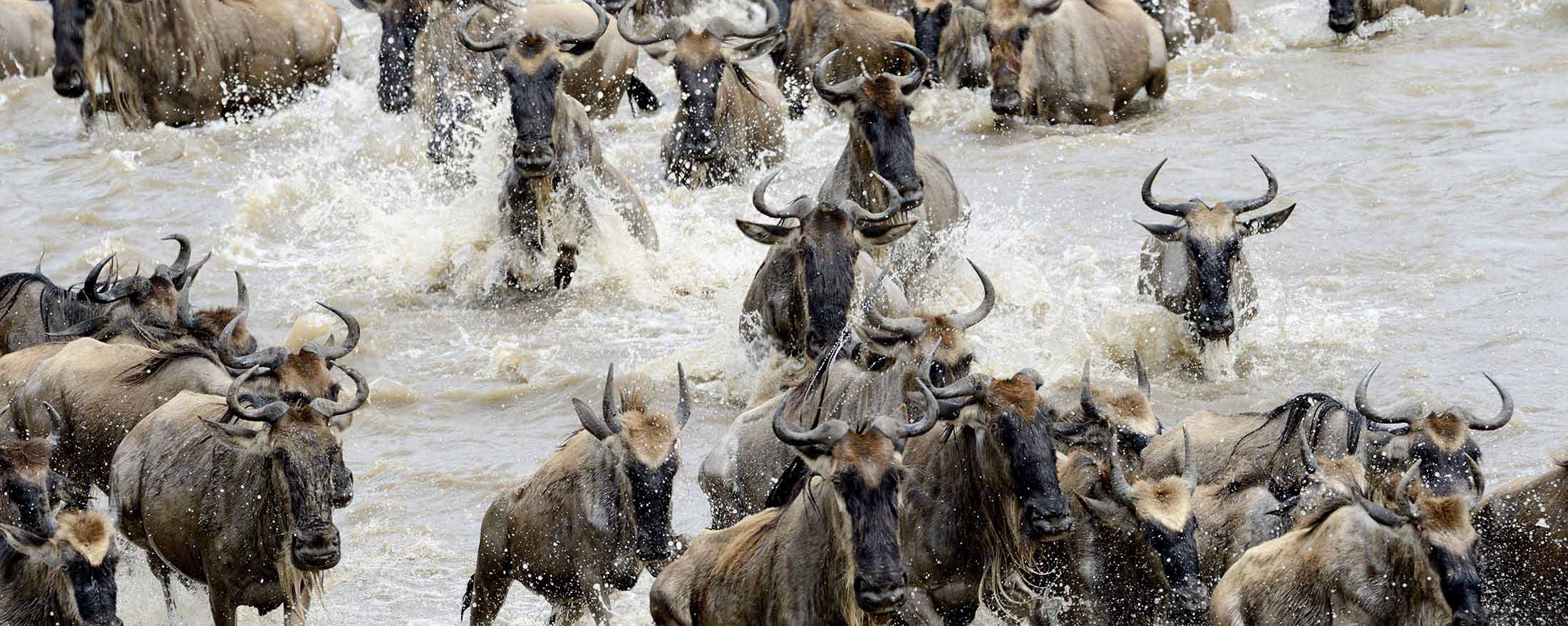
And then—when you’ve almost given up hope—it happens. One animal snaps. It jumps. And in a split second, 10,000 wildebeest lose their minds and hurl themselves into the river like it’s a flash sale at the mall.
The noise is deafening. The splashing is chaotic. Dust mixes with water. Crocodiles swirl underneath. And you’re left with your jaw on the floor, wondering how any of them make it to the other side.
That’s the magic. It’s not just the crossing itself. It’s the torturous, beautiful, anxiety-ridden buildup that makes it unforgettable.
But What If You Miss It?
Honestly? That happens. And it’s okay.
I know that sounds crazy when you’ve spent a ton of money to get there. But here’s the thing about the Great Migration: even when they’re not crossing, the sheer volume of life is overwhelming.
Imagine standing on a hill and watching a carpet of animals—over a million of them—slowly crawl across the plains. It moves like a river of brown and black. Zebras bark at each other. Wildebeest calves stumble and find their feet. Lions lounge in the grass, fat and happy, watching the buffet stroll by.
It’s not just a “crossing.” It’s an experience.
And if you miss the big splash? You’ll still see predators stalking the stragglers. You’ll still watch the sunset paint the sky in shades of orange while giraffes stand like silhouettes in the distance. You’ll still feel the ancient, primal rhythm of life on the move.
A Little Secret About the “Other” Side
Most people think you have to go to Kenya’s Maasai Mara to see the crossings. And sure, it’s incredible there.
But honestly? Some of my most intimate, goosebump-worthy moments have been on the Tanzanian side, in the northern Serengeti.
Why? Because there are way fewer jeeps.
In the Mara, you might be one of 50 vehicles lined up along the river, all jostling for a view. In the Serengeti, it’s just… you, the wilderness, and thousands of animals. The crossings happen here too—multiple times a day—and you’re not fighting for a photo angle. You’re just witnessing it. Quietly. Breathe it in.
My Honest Advice to You
If you’re really asking me, “When should I go?”—here is my real answer:
Go in August or September, but book a safari that’s at least 5 to 7 days long.
Why? Because crossing days are lottery tickets. The more days you spend out there, the more tickets you buy. Spend three nights, you might get lucky. Spend a week, and you’re almost guaranteed to see something—even if it’s just a small group of zebras nervously paddling across.
And for heaven’s sake, choose a guide who actually knows the herds. Not just a driver—a true, passionate, animal-obsessed guide who wakes up at 4 AM just to track the movements and calls his buddies on the radio to whisper, “They’re gathering at crossing point B.” That person is your golden ticket.
And One Last Thing: Forget the “Perfect” Shot
Put the camera down for a second.
I know you want the photo. I know you want to show your friends. But trust me—the best memories aren’t behind a lens. They’re the sound of 100,000 hooves drumming against the earth. They’re the nervous laugh you share with a stranger in the jeep when a wildebeest stares at you like you’re the crazy one. They’re the feeling of dust on your skin and the thrill of realizing you’re watching something that has happened for millennia, completely indifferent to our modern world.
The Mara River crossing isn’t a tourist show. It’s a raw, dangerous, messy, heartbreaking, exhilarating act of survival.
And if you get to see it? You’re one of the lucky ones.
If you don’t? You’re still in Africa, surrounded by the most incredible wildlife on Earth. That’s not a bad consolation prize.

Talk to us
- Email:
- Phone line:
- Whatsapp: